
Quneitra is a small governorate in the south-west by the Golan plateau, its dominant character agricultural and pastoral. The region is seeing a gradual return of residents and reconstruction activity after difficult years, and this creates two practical needs, no more: barns and agricultural facilities serving farming and livestock, and service buildings delivered quickly and at a reasonable cost to bring life back to the villages and towns. We will not exaggerate in describing the region; it is not a large industrial centre nor a zone of huge warehouses, but an agricultural area needing simple practical solutions. A steel facility suits this need specifically because it is fast to build, flexible to expand, and economical compared to traditional construction. This article is about Quneitra in this honest reality: what someone building a steel hangar here actually needs.
Note: The local considerations are general and vary by site; they do not replace a soil investigation, a signed structural study for the specific project, and a licence from its municipality.
1. Why does Quneitra differ?
Quneitra is not a large industrial governorate, and it is honest to describe it as it is: a small agricultural and pastoral region by the Golan, seeing a gradual return of residents and reconstruction. This reality sets the kind of facilities needed here: barns and agricultural buildings, and small to medium service facilities serving the returning villages, not huge industrial complexes.
The first need is agricultural and pastoral: barns for livestock, stores for feed and farm equipment, and canopies that protect from sun and rain. These are practical buildings that need no complexity, but they need correct execution that lasts years without costly maintenance.
The second need is reconstruction: as residents return, the need rises for buildings delivered quickly and at a reasonable cost — small stores, workshops, service facilities. Here the steel facility's advantage stands out: faster than traditional building, expandable later, and light on the soil.
The structural principles themselves do not change — isolated footings, a portal frame, corrosion protection — but in Quneitra two factors come forward: speed and economy of execution, and simplicity of agricultural solutions. We build here around these two without exaggeration. See the complete guide to steel hangar construction in Syria for the overall picture.
2. Fast-built reconstruction facilities
The steel facility's advantage in the reconstruction phase is clear: speed. While the foundations are prepared on site, the structure is fabricated in the shop in parallel, so when the structure arrives the work is fast assembly, not fabrication from scratch. This shortens the time compared to traditional building done layer by layer on site.

Our actual durations include foundations, not the structure alone: small (15–20 m span / ~500 m²) about 30 days, medium (25–30 m / 1,000–1,500 m²) 45–50 days, large (35 m+ / 2,000 m²+) about 65 days. Most Quneitra facilities fall in the small and medium categories, delivered in relatively short times that suit the pace of return and reconstruction. Detail in how to build a steel hangar: step by step.
Economy is a second, equally important factor for a region in recovery. A steel frame is light, so its foundations are smaller and cheaper, its specification is clear and calculable in advance, and there are no cost surprises if the site and use are described precisely. For anyone wanting a faster and simpler solution still, a prefabricated steel building suits some service and agricultural uses.

Flexibility is a third advantage: a steel building is expanded or modified later more easily than concrete, useful for a region growing gradually with returning residents, so a project owner starts with what they need now and expands when conditions allow, instead of building large and empty from the start.
3. Barns and agricultural facilities
Quneitra's agricultural and pastoral character makes barns and agricultural facilities the clearest use for a steel hangar here. A livestock barn needs good ventilation to discharge heat, humidity and odours, adequate natural light, and a suitable floor and drainage. An open or semi-open steel building meets these requirements flexibly.

Feed and farm equipment stores need protection from rain and humidity, and an open space for machinery movement. A wide clear span free of intermediate columns is an advantage here too, though at a smaller scale than the large grain stores in the wider agricultural regions. Detail in agricultural steel buildings.
The Golan climate is milder than the desert east: highlands that carry winter cold and may carry snow entering the roof load, and rains needing good drainage by the fixed roof slope (12–15%). The insulation decision here follows the use: an open-ventilated livestock barn differs from a store keeping moisture-sensitive feed, and we design each to its need, not a single template.
Simplicity is intended here, not a shortfall: a good agricultural building in Quneitra is not a complex, expensive one, but a practical, correctly designed building that lasts years with simple maintenance and serves its purpose without excess cost. That suits a returning farmer or herder who wants a solution to rely on, not a project costing more than their need.
4. Soil and execution in the Golan
Quneitra's soil in the Golan is mostly fertile volcanic ground, varying between rocky sites and soft agricultural ones. This variation sets foundation size and cost, and a footing design cannot be carried from one site to another. The strict rule: foundation cost cannot be estimated before a soil investigation, because the soil bearing capacity sets the footing area, depth and reinforcement. See steel building foundations explained.
A steel frame is light, so its footings are smaller than concrete, an important economic advantage for a region in reconstruction. The design wind speed on exposed highlands enters the calculation and is fixed in the contract, and a light building is sensitive to uplift, so the values are computed precisely per site and not left to estimate.
Access is a local consideration in a region where some sites may be on rural edges or mountain roads. We study the approach road and crane manoeuvring space early, not on erection day, because access surprises cost more than structure surprises once the crew is on site. The region's distance from fabrication centres makes studying transport part of the early planning.
As for the licence, in practice a municipal licence is required, usually obtained by the client, and we supply the drawings and specifications the municipality asks for, beginning its procedures early in parallel with design. The full cost breakdown is in the steel hangar price quote, so the quotation comes close to the final figure without surprises.
5. Cost and payments for Quneitra projects
In a region in recovery like Quneitra, economy is not a luxury but a practical condition. A steel facility helps here because its specification is clear and calculable in advance, so there are no cost surprises if the site and use are described precisely. The frame is light, so its foundations are smaller and cheaper, a real difference in a small agricultural or reconstruction project that cannot bear extra items.
The steel price itself does not change by governorate, but the total cost follows local factors: the soil that sets the foundations, access on sites that may be rural or mountainous, and the distance from the shop to the site. That is why we describe the items plainly rather than hiding them, so a returning farmer or herder builds their decision on an honest figure, not an estimate that changes after inspection.
As an approximate, not final, reference: a tonne of structure raw ranges between 800 and 1,050 dollars, and fabricated and erected between 1,150 and 1,500 dollars, at a design weight between 28 and 40 kilograms per square metre depending on span and loads. The small and medium projects that dominate the region tend toward the lower-cost end compared to large facilities, which suits the reconstruction stage.
That is why we set out the scope explicitly: what is in (the structure, cladding, protection) and what follows the site (foundations after a soil test, transport, lifting). An honest quotation states these items rather than staying silent so they return as a surprise.
Cost is paid in instalments tied to completion stages: a deposit at contracting, then payments when the structure arrives, at erection, and at handover. This order protects both sides and keeps fabrication flowing, suiting a small project owner who wants to tie payments to progress they see, not to promises.
Our advice to anyone starting now is not to build larger than their current need. A steel facility is expanded later easily, so start with what you need today and expand when conditions and the pace of return allow, instead of freezing money in an empty, unused space. That is the best way to protect the budget of a project in a gradually growing region.
6. We work across all governorates, and the next step
We build in Quneitra and all governorates, with periodic maintenance after handover and a 15 to 25 year warranty. What changes in Quneitra is the smaller scale of the projects and their agricultural and reconstruction character, not the quality of the work nor the protection specification. We do not exaggerate in describing the region; we offer a practical solution that suits a real need.
Quick questions:
Is a steel facility suitable for a small region like Quneitra? Yes, especially for small and medium projects, because it is fast, economical, and expandable later.
Is it suitable for livestock barns? Yes, with ventilation, natural light and suitable drainage, and we design it to the type of use.
How long for a small building? About 30 days including foundations for a small building, sped up by handing over a ready site.
Contact us to discuss your agricultural or reconstruction project in Quneitra, or request a quotation with your dimensions and use. The overall picture is in building a steel hangar in Syria.
- Quneitra
- Golan
- Agricultural barns
- Reconstruction
- Fast build
Frequently asked questions
What sets building a steel hangar in Quneitra apart?
Being a small agricultural and pastoral region seeing residents return and reconstruction. The dominant need is barns, agricultural facilities and fast, economical service buildings, not large industrial complexes. We describe the region as it is, without exaggeration.
Is a steel facility suitable for Quneitra's small projects?
Yes, especially for the small and medium projects that dominate the region. A steel facility is fast to build, economical with smaller foundations, light on the soil, and expandable later as the need and the pace of return grow.
Are steel structures suitable for livestock barns?
Yes. A livestock barn needs good ventilation to discharge heat and humidity, natural light, and suitable drainage, and an open or semi-open steel building meets this flexibly. We design the barn to its type of use, not a single template.
How long does a small building take in Quneitra?
A small building (15–20 m span / ~500 m²) takes about 30 days including foundations, and a medium one 45–50 days. Most regional projects are in these two categories, delivered quickly to suit the pace of return and reconstruction. A ready site speeds it up.
How does the Golan climate affect the design?
The Golan climate is milder than the desert east, but its highlands carry winter cold and may carry snow entering the roof load, and rains needing good drainage by the fixed roof slope. The insulation decision follows the use: an open barn differs from a feed store.
Have a project like this?
Leave your number and a short brief, and we will come back with a preliminary study and clear quotation items within one business day.
Read next
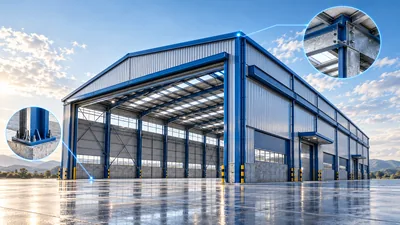 The complete guide
Steel hangar construction: the complete guide
Everything a decision-maker needs before building a steel hangar — from span and cost to protection and build time, with figures from delivered projects.
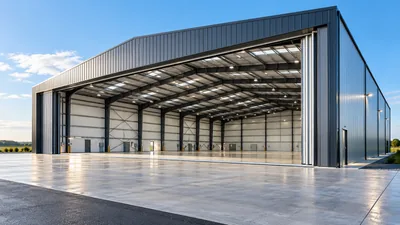 For sale
Steel hangars for sale in Syria
Buying a steel hangar is not picking a product off a shelf; it is ordering a structure engineered to your use and your site. Here is what you buy, how, and at what price.
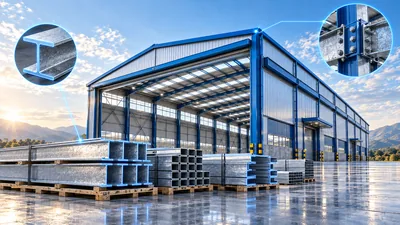 Cost and pricing
How much does a steel hangar cost?
Cost is calculated by the tonne, not the square metre alone. Here are the real price items, and where a cheap quote is a trap.