
Raqqa sits on the Euphrates like its eastern neighbour, but its focus differs: here it is cotton, wheat, the dam and reconstruction, not oil fields. The governorate was and remains one of Syria's most important cotton and grain regions, and as farming revives and the reconstruction wave builds, the need grows for stores that preserve the crop and buildings delivered quickly to restore economic life. On top of that is a continental desert climate struck by dust storms in certain seasons, which imposes two conditions above all on a steel hangar here: that it preserve cotton and grain from heat, humidity and dust, and that its envelope withstand dust-laden wind. This article is about Raqqa as an agricultural and reconstruction region with its own climate, for anyone who wants to know what differs locally before building.
Note: The local considerations are general and vary by site; they do not replace a soil investigation, a signed structural study for the specific project, and a licence from its municipality.
1. Why does Raqqa differ from its neighbours?
It is easy to lump the Euphrates governorates into one basket, but Raqqa has its own economic identity. Its focus is agriculture — cotton and wheat specifically — then the dam and its related projects, then the reconstruction wave that needs stores and service buildings. This differs from an oil-dominated region, and it is reflected directly in the kind of building needed here.
The first priority in Raqqa is agricultural storage. Ginned or baled cotton, and grain of all kinds, need wide stores that preserve the crop from heat, humidity and dust until the marketing season, not mere canopies that block the sun. A well-insulated steel building is the practical answer to this need.
The second priority is reconstruction buildings: stores, small factories and workshops that restore economic activity, needing to be delivered quickly and at a reasonable cost. A steel structure serves this goal because it is faster than traditional building and more flexible for later expansion.
The structural principles themselves do not change — isolated footings, the portal frame, corrosion protection — but the order of priorities follows this local economy. In Raqqa, crop preservation and resisting dust come ahead of everything else. See the complete guide to steel hangar construction in Syria for the overall picture.
2. Cotton and grain storage
Storing cotton is a more delicate matter than it seems. Cotton is sensitive to humidity that lowers its grade and may cause rot, to high heat that affects its fibres, and to dust that contaminates it. A well-insulated, carefully ventilated steel store handles these three factors together, preserving the crop's quality until the selling season instead of losing part of it to poor storage.

Grain has slightly different requirements: it needs wide spaces with few columns to ease loading, unloading and equipment movement, and ventilation that prevents moisture buildup spoiling the stock. A wide clear span free of intermediate columns is a real advantage here, allowing crop stacking and free machinery movement inside the store.
The choice of insulation thickness (5, 6, 8 and 10 cm) and cladding type (sheet, sandwich panel or skorit) follows the crop type and its storage duration. A short, seasonal store is not the same as a long-keeping one, and we design each to its use. Detail in agricultural steel buildings and steel warehouse construction.
When the store is for large commercial storage — not a single farm — extra considerations enter, such as truck lanes, loading docks and internal space division. These are studied from the start because altering them after construction is costly, and a successful store is designed around how it operates, not its area alone.
3. The desert climate and dust storms in the design
Raqqa's climate is continental desert: a long hot summer, a cold winter, and dust storms striking the region in certain seasons. A dust storm is not mere nuisance; it is a load on the envelope, pressure on the openings, and a source of accelerated corrosion when dust settles with moisture on surfaces and joints. That is why dust enters the design, not maintenance alone.
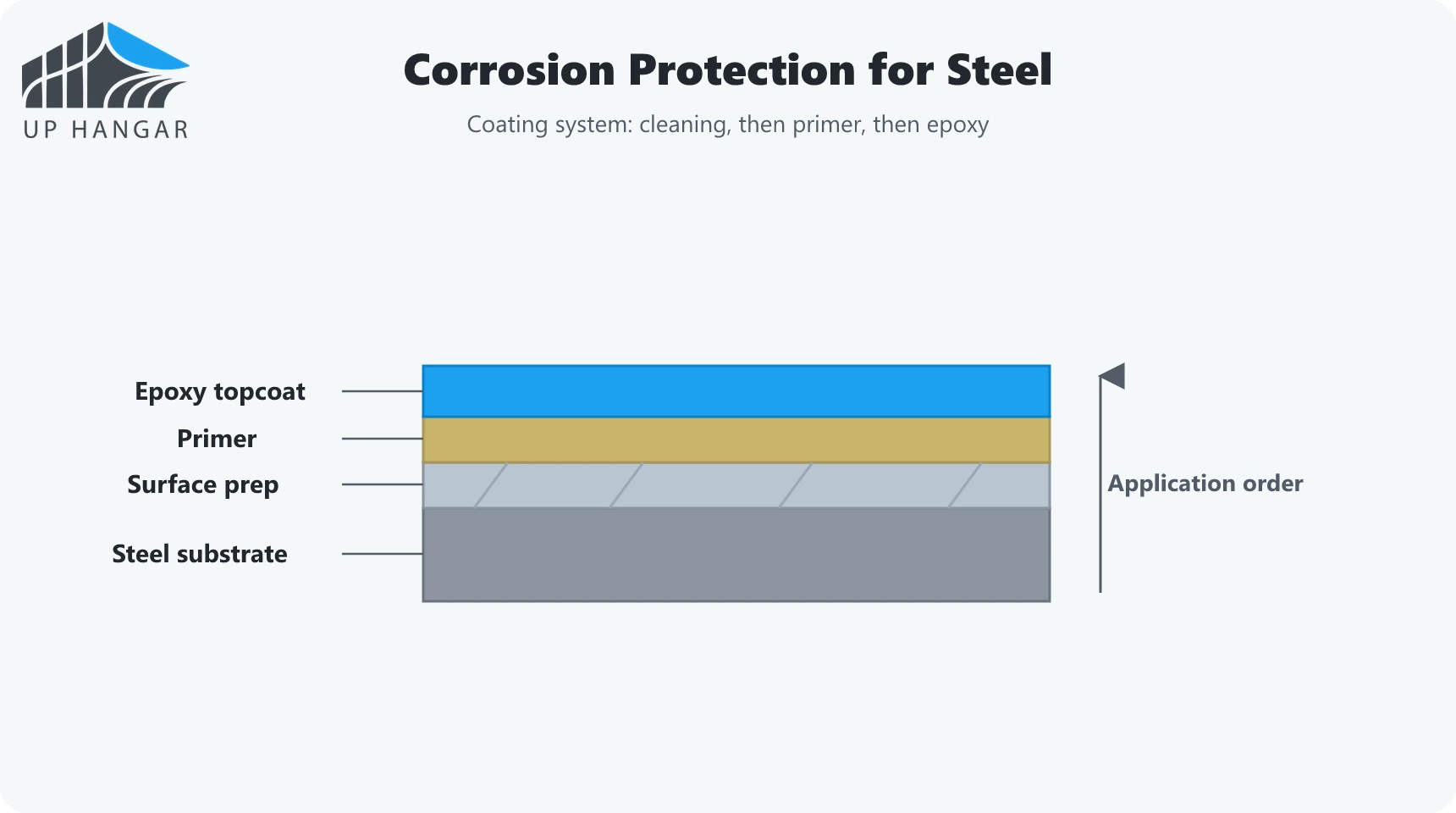
We meet dust with three design decisions. First, sealing the openings: doors, windows and ventilation openings designed to block dust ingress while keeping heat discharge possible. Second, a suitable corrosion-protection system — cleaning, primer and an epoxy layer — that resists the dusty environment accelerating rust. Third, details that avoid points where dust and moisture settle in the joints.
Heat is a parallel factor: Raqqa's summer makes insulation an operating decision in stores keeping a sensitive crop, and the cost of spoiled stock in an uninsulated building quickly exceeds what was saved on insulation. The wide day-to-night temperature swing creates a condensation risk handled by a vapour barrier and correct insulation. See cladding and insulation: preventing condensation and leaks.
On exposed ground like Raqqa the design wind speed enters the calculation directly and is fixed in the contract. Raising the wind value raises the weight and cost, and lowering it below reality saves tonnes today and buys a risk in the first strong storm. These values are computed per site and delivered documented within the structural study, not left to estimate.
4. Soil and execution on the Euphrates banks
Raqqa's soil varies between soft agricultural ground near the Euphrates and irrigation channels, and firmer ground away from the river. This variation sets foundation size and cost before anything else, and a footing design cannot be carried from a riverside site to a desert one. The strict rule: foundation cost cannot be estimated before a soil investigation, because the soil bearing capacity sets the footing area, depth and reinforcement.
A steel frame is light, so its footings are smaller than a concrete building of the same function, an advantage on weak agricultural soil near the river. Groundwater near the Euphrates and irrigation channels is an extra factor that can rise seasonally, affecting foundation depth and footing waterproofing. See steel building foundations explained for what actually gets calculated.
Our actual durations include foundations, not the structure alone: small (15–20 m span / ~500 m²) about 30 days, medium (25–30 m / 1,000–1,500 m²) 45–50 days, large (35 m+ / 2,000 m²+) about 65 days. The advantage of parallel fabrication benefits reconstruction in Raqqa: while foundations are prepared, the structure is fabricated in the shop, so when it arrives the work is fast assembly. Detail in how to build a steel hangar: step by step.
As for the licence, in practice a municipal licence is required, usually obtained by the client, and we supply the drawings and specifications the municipality asks for. We begin its procedures early in parallel with design, not after it. The full cost breakdown is in the steel hangar price quote.
5. Cost and payments for Raqqa stores
The steel price itself does not change from one governorate to another, but the total cost of a store in Raqqa follows clear local factors: the soil that sets foundation size, the access that governs transport and lifting cost, and the distance over which the structure is hauled from the shop to the site. Two stores identical in area and specification can differ in final cost because of these local items alone, so do not be surprised if two quotations for similar projects on different sites differ.
That is why, when you request a quotation for a cotton or grain store, describe your need precisely: the location and ground nature, the crop type and its expected storage duration, and the area and height you need for stacking. The more precisely the client describes the need, the closer the quotation comes to the final figure and the less it is adjusted after inspection, sparing us both surprises that appear late on site.
As an approximate reference, not a final figure: a tonne of structure raw ranges between 800 and 1,050 dollars, and fabricated and erected between 1,150 and 1,500 dollars, at a design weight between 28 and 40 kilograms per square metre depending on span and loads. These are indicative ranges, and the precise figure follows your project's design and specification, not a general estimate.
That is why we set out the scope explicitly in the quotation: what is in it (the structure, cladding, corrosion protection) and what follows the site (foundations after a soil test, transport, lifting). An honest quotation states these items rather than staying silent so they return as a surprise after contracting.
Cost is paid locally in instalments tied to completion stages: a deposit at contracting, then payments when the structure arrives, at erection, and at handover. This order protects both sides: it keeps fabrication flowing on ours, and ties your payments to tangible progress you see on the ground on yours.
Any disruption to the payment schedule reflects directly on the timeline, because a late payment halts fabrication while funding is awaited. We therefore advise fixing a realistic schedule from the start and keeping to it, as it is among the most effective ways to speed the project and protect it from a needless stoppage.
6. We work across all governorates, and the next step
We build in Raqqa and all governorates, with periodic maintenance after handover and a 15 to 25 year warranty. What changes in Raqqa is the use focus — cotton and grain storage and reconstruction buildings — and the intensity of dust and heat, not the quality of the work nor the protection specification. A store that preserves a cotton or grain crop is designed around its contents and climate, not a generic template.
Quick questions:
Is a steel store suitable for cotton? Yes, if well insulated and carefully ventilated, because cotton is sensitive to humidity, heat and dust together, and these are handled by the design.
How do you meet dust storms? By sealing openings, a suitable corrosion-protection system, and details that prevent dust and moisture settling in the joints.
How long for a medium store? About 45–50 days including foundations, sped up by handing over a ready site and keeping to the payment schedule.
Contact us to discuss your site and crop in Raqqa, or request a quotation with your dimensions and use. The overall picture is in building a steel hangar in Syria.
- Raqqa
- Cotton and grain
- Dust storms
- Warehouses
- Reconstruction
Frequently asked questions
What sets building a steel hangar in Raqqa apart?
Its focus is agriculture — cotton and wheat — the dam and reconstruction, not oil. So the priority is stores that preserve the crop and buildings delivered quickly, with a desert climate struck by dust storms that imposes conditions on the envelope.
Is a steel hangar suitable for storing cotton and grain?
Yes, if well insulated and carefully ventilated. Cotton is sensitive to humidity, heat and dust, and grain needs wide spaces and ventilation preventing moisture. An insulated steel store preserves the crop's quality until the selling season.
How are dust storms handled in the hangar design?
With three decisions: sealing openings and doors while keeping heat discharge, a corrosion-protection system suited to the dusty environment, and details preventing dust and moisture settling in the joints where rust accelerates.
Is insulation necessary for Raqqa stores?
For stores keeping a sensitive crop, yes, because Raqqa's hot summer spoils stock in an uninsulated building, and the wide temperature swing creates a condensation risk handled by a vapour barrier and correct insulation decided in the design.
How long does an agricultural store take in Raqqa?
Actual durations including foundations: small about 30 days, medium 45–50 days, large about 65 days. Sped up by handing over a ready, cleared site, keeping to the payment schedule, and approving drawings quickly.
Have a project like this?
Leave your number and a short brief, and we will come back with a preliminary study and clear quotation items within one business day.
Read next
 The complete guide
Steel hangar construction: the complete guide
Everything a decision-maker needs before building a steel hangar — from span and cost to protection and build time, with figures from delivered projects.
 For sale
Steel hangars for sale in Syria
Buying a steel hangar is not picking a product off a shelf; it is ordering a structure engineered to your use and your site. Here is what you buy, how, and at what price.
 Cost and pricing
How much does a steel hangar cost?
Cost is calculated by the tonne, not the square metre alone. Here are the real price items, and where a cheap quote is a trap.