
Hama is an agricultural governorate par excellence, and its heart is the Ghab plain: a fertile plain producing grain, cotton, Aleppo pistachio and other crops that need storage and processing before reaching the market. An agricultural crop is not stored like any other goods: it is sensitive to heat and humidity and spoils if stored badly. So the design of an agricultural hangar in Hama starts from a different question than a factory or a logistics warehouse: how do I protect the crop from summer heat and condensation humidity throughout its storage period. This article is specific to Hama: grain stores in the Ghab plain, agri-processing, and the pivotal role of thermal insulation in protecting the stock — so a farmer or agricultural operator decides on a clear basis.
Note: The agricultural considerations are general and vary by crop and site; they do not replace a soil investigation, a signed structural study for your project, and a licence from its municipality.
1. Grain and cereal stores in the Ghab plain
The Ghab plain, west of Hama, is one of Syria's most fertile plains, producing grain, cotton, pistachio and seasonal crops that all flow in defined seasons and need storage to preserve them until marketing or processing. A grain store is not an empty box: it is a building that protects a crop the farmer laboured over for a full season, and any flaw in storage turns into a direct loss in quantity and quality.
A steel frame suits grain stores because it provides a wide open space with no columns obstructing handling and bagging, a height allowing bulk storage or bags stacked high, and large doors for farm machinery and trucks to enter during the crowded harvest season. Speed of delivery is an added advantage: a store ready before the season receives its crop, while one that is late misses a full season.

Agri-processing accompanies storage: mills, presses and sorting and packing plants turn the raw crop into a marketable product. These facilities need the same open space and flexibility in laying out lines, and the steel frame serves them as it serves the store. See agricultural steel buildings and building steel warehouses.
The practical rule for a grain store: define your crop and its storage period before design. Grain stored for long months in a hot summer needs different protection from a crop that passes through quickly. Describing the use correctly is what sets the level of insulation and ventilation required, which is what we turn to now.
2. Thermal insulation to protect the stock
Here an agricultural hangar in Hama differs from a factory and a logistics warehouse: thermal insulation is not a luxury but a means of protecting the crop itself. A crop stored in an uninsulated building is exposed to a hot interior summer heat that raises its temperature, accelerates its spoilage and activates insects and mould, and the day-to-night temperature difference causes condensation that drips onto the bags and wets the grain so it rots unseen.
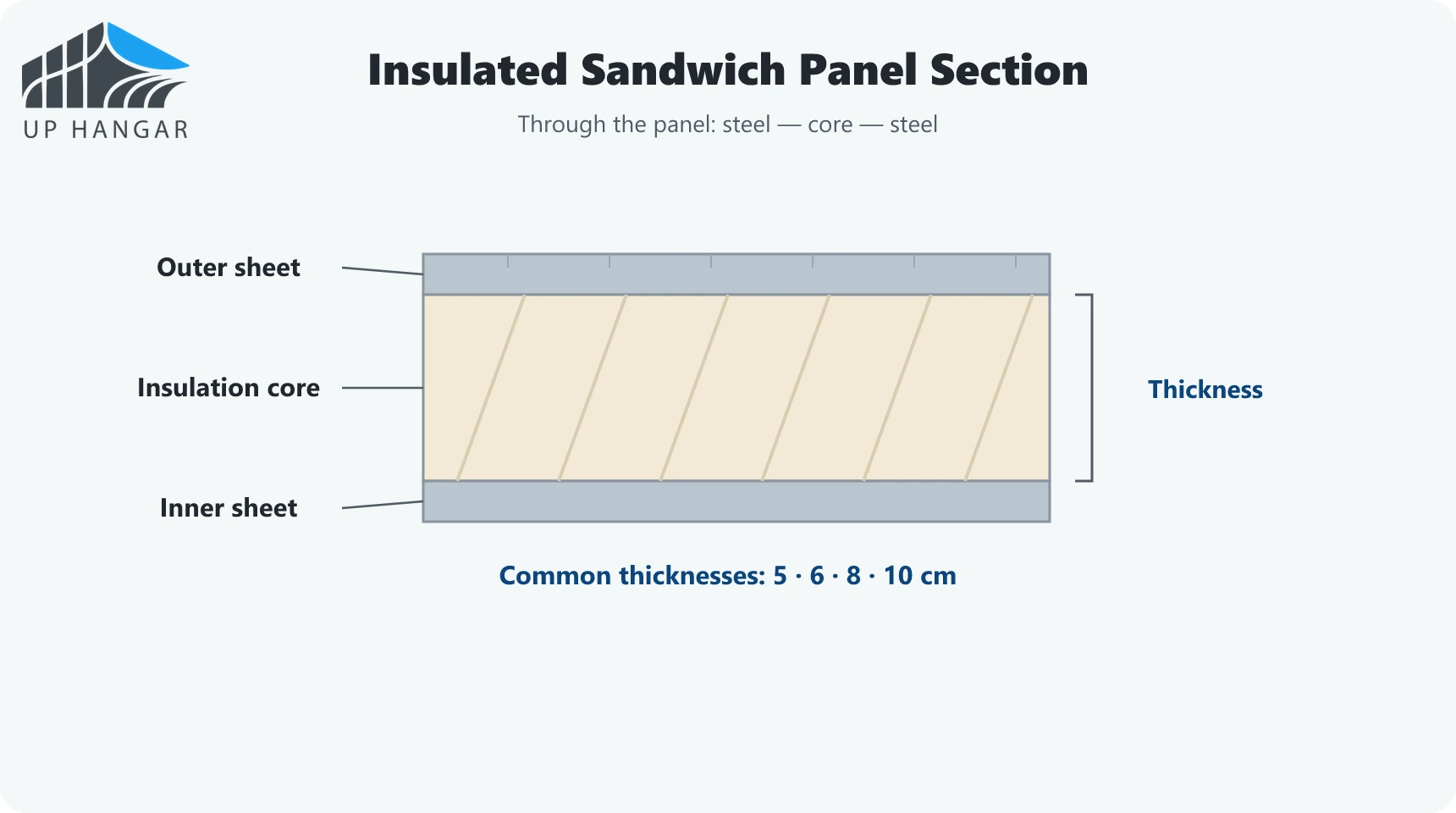
Insulation in its thicknesses (5, 6, 8 and 10 cm) with a correct vapour barrier holds the interior temperature relatively steady and cuts off the path of condensation. The choice of thickness and cladding type — sheet, sandwich panel or skorit — follows the crop, its storage period and the site climate, not the budget alone. A sensitive crop stored for long deserves heavier insulation, because the cost difference comes back preserved in the stock's quality.
The vapour barrier is a decision made in design, not added later: it is a layer placed in its correct position within the wall and roof build-up to stop water vapour from reaching the cold interior face and condensing on it. The layers and their functions are detailed in steel building insulation and cladding and insulation: preventing condensation and leaks.
The conclusion the farmer and operator must grasp: insulation in an agricultural hangar is an investment in protecting the crop, not a decorative item. The cost of cooling or loss in an unprotected crop quickly eats what was saved on cheap insulation, and the correct decision is reckoned over the years of storage, not on construction cost alone.
3. Cold storage for sensitive crops
Some of Hama's crops and agricultural products need more than insulation: they need actual refrigeration. Fruits, vegetables and products needing a controlled temperature to keep their freshness until marketing move the design from the insulated warehouse to a cold storage building, with its heavier insulation, tighter sealing and refrigeration systems.
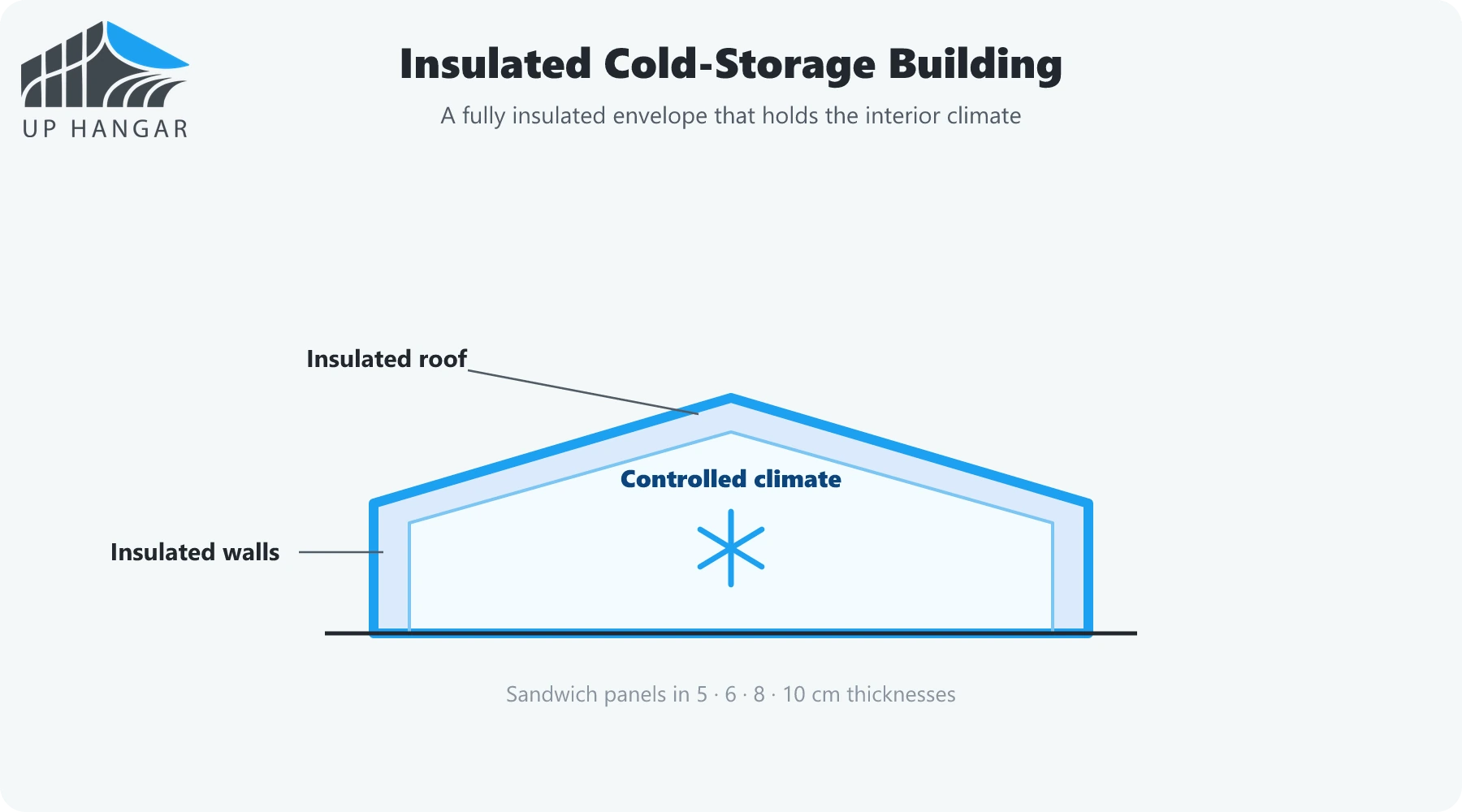
The difference between an insulated and a refrigerated warehouse is one of degree and aim: the insulated one holds the temperature relatively steady and prevents condensation, while the refrigerated one actually lowers the temperature to a controlled level and maintains it. The more tightly the temperature is controlled, the stronger the requirements for insulation, sealing and the prevention of thermal bridges in design, because any heat leak raises the running cost continuously.
So cold storage is studied as a specialism in its own right from design, not as an add-on to an ordinary warehouse. See the cold storage and logistics building to understand what it actually requires, and the full national picture in building a steel hangar in Syria.
The farmer's decision here is economic with a seasonal reach: cold storage allows the crop to be sold outside the glut season when its price rises, recovering its cost through the seasonal price difference. This is a calculation that precedes construction, and we help the project owner estimate it clearly before committing to a given cooling level.
4. Cost and time for an agricultural facility in Hama
Agricultural facilities in Hama range from a simple grain store to a processing or cold storage facility. Our actual durations include the foundations: small (15–20 m span / ~500 m²) about 30 days, medium (25–30 m / 1,000–1,500 m²) 45 to 50 days, and large (35 m+ / 2,000 m²+) about 65 days. In farming the schedule is critical: readiness before the season means receiving the crop, and lateness means missing it.
Cost is measured by the tonne: the raw tonne runs roughly between 800 and 1,050 dollars, and fabricated and erected between 1,150 and 1,500 dollars, at a frame weight of 28 to 40 kilograms per square metre depending on span, height and load. To this is added the cost of insulation, which follows the level of protection required: an insulated grain store costs more than an open shed, and a refrigerated one more than both.
So an agricultural facility is not compared on price per square metre alone: an insulated grain store differs fundamentally from a simple farm shed of the same area. Ask for an explicit breakdown of items — structure, cladding, insulation, and what follows the site. Detail in the steel hangar quotation and the complete guide to steel hangar construction.
Foundations remain estimated after a soil test, not before it, which matters in the Ghab plain specifically, where groundwater may rise seasonally on some sites near watercourses, affecting the founding depth and footing waterproofing. Anyone who gives you a foundation cost before a soil test is giving you a number resting on nothing.
5. We build across Hama and the Ghab: the next step
We build in Hama, the Ghab plain and all governorates, with periodic maintenance after handover and a 15 to 25 year warranty. What changes in an agricultural project is the level of insulation and refrigeration by crop and storage period — not the quality of the work nor the corrosion protection specification.
Common questions:
Why is insulation important in a Hama grain store? Because the crop is sensitive to heat and humidity; an uninsulated building heats up in summer and develops condensation that wets and rots the grain. Insulation with a vapour barrier protects the stock throughout its storage period.
What is the difference between an insulated and a refrigerated crop store? The insulated one holds the temperature relatively steady and prevents condensation, while the refrigerated one actually lowers it to a controlled level for crops needing freshness, with heavier insulation and tighter sealing.
When must the agricultural store be ready? Before the harvest season. Readiness before the season means receiving the crop, and lateness misses a full season, so we keep to a schedule that respects the farming season.
Contact us to discuss your agricultural facility in Hama or the Ghab plain, or request a quotation with your dimensions, crop and storage period.
- Hama
- Ghab plain
- Grain storage
- Thermal insulation
Frequently asked questions
Why is thermal insulation pivotal in Hama’s agricultural hangars?
Because the crop is sensitive to heat and humidity. An uninsulated building heats up in summer and develops condensation that drips onto the bags and rots the grain. Insulation with a vapour barrier protects the stock throughout storage, so it is an investment in the crop, not a decorative item.
What specifications suit a grain store in the Ghab plain?
A wide open space with no columns obstructing handling, a height allowing bulk storage or stacked bags, and large doors for machinery and trucks in the season, with insulation following the crop and its storage period.
What is the difference between an insulated and a refrigerated warehouse?
The insulated one holds the temperature relatively steady and prevents condensation, while the refrigerated one actually lowers it to a controlled level and maintains it for crops needing freshness. The refrigerated one requires heavier insulation, tighter sealing and prevention of thermal bridges in design.
Does the Ghab plain groundwater affect foundations?
Groundwater may rise seasonally on sites near watercourses, affecting the founding depth and footing waterproofing. So foundations are estimated after a soil test, not before it, and a design is not generalised from one site to another.
How long and how much for an agricultural facility in Hama?
Small (~500 m²) about 30 days, medium (1,000–1,500 m²) 45–50 days, large (2,000 m²+) about 65 days including foundations. Cost is by the tonne: raw 800–1,050 dollars and fabricated and erected 1,150–1,500 dollars, plus the cost of insulation by the protection required.
Have a project like this?
Leave your number and a short brief, and we will come back with a preliminary study and clear quotation items within one business day.
Read next
 The complete guide
Steel hangar construction: the complete guide
Everything a decision-maker needs before building a steel hangar — from span and cost to protection and build time, with figures from delivered projects.
 For sale
Steel hangars for sale in Syria
Buying a steel hangar is not picking a product off a shelf; it is ordering a structure engineered to your use and your site. Here is what you buy, how, and at what price.
 Cost and pricing
How much does a steel hangar cost?
Cost is calculated by the tonne, not the square metre alone. Here are the real price items, and where a cheap quote is a trap.