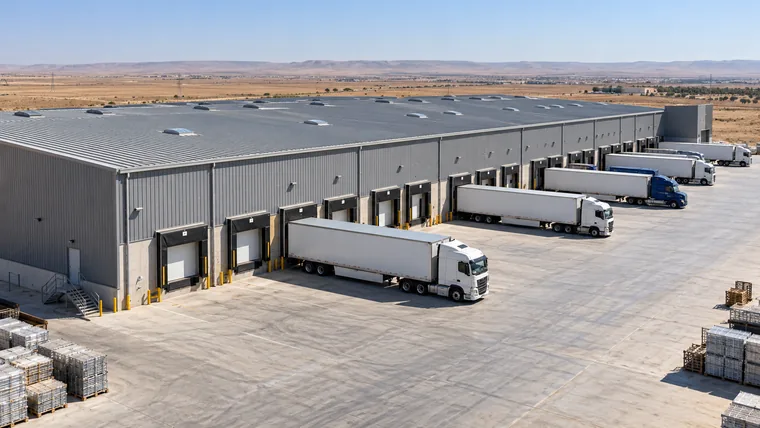
Homs is the geographic heart of Syria: the roads of the north, south, coast and interior meet there, making it the natural location for the distribution warehouses and logistics centres that serve the whole country, alongside its heavy industry and refinery. Anyone distributing goods across the governorates looks for a central point that cuts transport distances and times, and Homs is that point. This article is specific to Homs — not a repeat of what is said about any city: how a steel distribution warehouse is designed to serve a national logistics role, the part played by Hisya Industrial City, the specifications of large warehouses, and how they are priced and timed — so a logistics or industrial operator decides on a clear basis.
Note: The logistics and industrial considerations are general and vary by site and goods; they do not replace a soil investigation, a signed structural study for your project, and a licence from its municipality.
1. Homs, a central hub for distribution and warehousing
What sets Homs apart from any other governorate is its location: a crossing point linking Damascus and the south with Aleppo and the north, and the coast with the steppe and interior. This central position is not a geographic detail but a direct economic advantage: a warehouse in Homs reaches any governorate in less time and distance than any peripheral site. That is why distribution centres serving the national market cluster there.
A logistics warehouse differs in design from a factory: it does not necessarily need a heavy overhead crane, but it needs a wide open space to organise racking and aisles, a suitable eaves height for high storage, and large multiple doors for truck movement and loading docks. A steel frame provides this open space at a reasonable weight and in a short time, which serves a logistics operation wanting to go live quickly.
In logistics, time is money: every day of delay in opening a distribution centre is a delay in serving an entire network of customers. That is why logistics companies specifically choose the steel frame for its speed of delivery. See building steel warehouses and the industrial hangar: factory and warehouse requirements.
In practice, a logistics decision-maker thinks in networks, not in a single building: a central warehouse in Homs may replace several peripheral ones, or act as a collection and distribution point feeding smaller branches. The building design follows this role — manoeuvring space, the number of loading doors, the layout of internal aisles — not the area alone.
2. Hisya Industrial City and distribution warehouses
Hisya Industrial City, south of Homs, is one of the largest industrial and logistics clusters in the central region, and its position on the Damascus–Homs axis reinforces that same distribution role. Its facilities blend industry with storage and distribution, a mix that suits the steel frame perfectly because it allows industrial halls and warehouses to the same specification and with the same speed of delivery.
A warehouse in Hisya or on the industrial edges of Homs is designed around truck movement: a clear entry and exit, manoeuvring space for long trucks, loading docks at a suitable height, and large doors that admit forklifts. These operational details are studied in design because they determine the warehouse's daily efficiency, not just its one-time handover.
For the area and its detail see Hisya Industrial City, and for the full national picture building a steel hangar in Syria. We work in Hisya, Homs and their industrial surroundings, and we design the warehouse around its logistics role, not as an empty box.
An added advantage of the central location shows at the execution stage itself: Homs's proximity to supply sources and transport axes eases the arrival of the structure to site, a factor in the transport and lifting cost that follows access, not the area alone. This relatively easier access is a real local advantage for Homs compared with hard-to-reach peripheral sites.
3. Specifications of a large logistics warehouse
A large warehouse is measured in three dimensions, not area alone: the clear span that sets the width of the open hall, the eaves height that sets the storage height, and the door layout that sets movement efficiency. An eaves height of four to ten metres allows multi-level racking that multiplies capacity on the same footprint, and this is the core of modern warehouse economics.
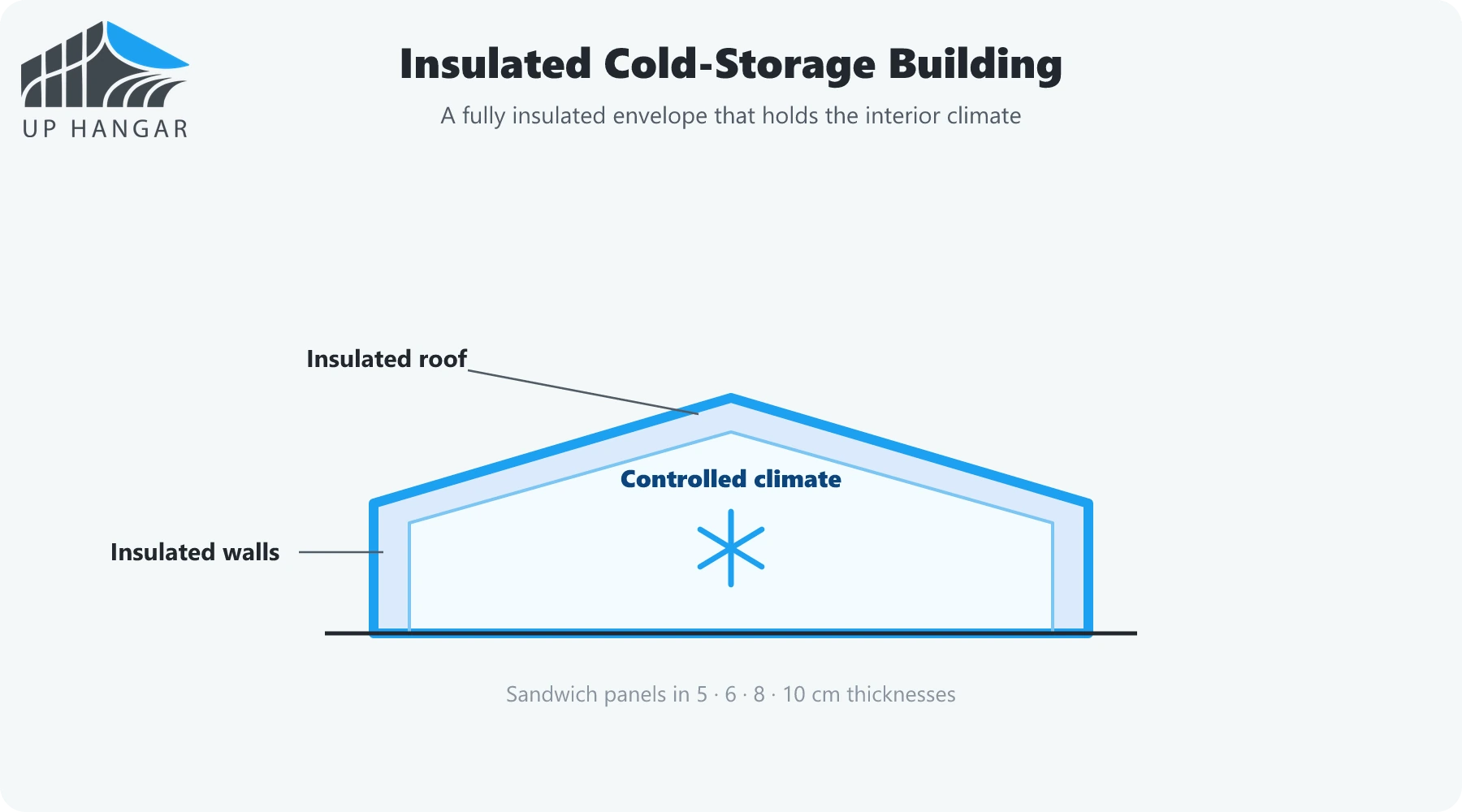
Cladding and insulation follow the type of goods stored: a warehouse for dry, heat-insensitive goods differs from one for products needing controlled temperature. When goods are sensitive, insulation in its thicknesses (5, 6, 8 and 10 cm) and a vapour barrier become an operating decision, because the temperature difference causes condensation that drips onto goods and spoils them unseen.
For warehouses needing actual refrigeration — food or pharmaceuticals — the design moves into the field of cold storage, with its heavier insulation and tighter sealing, a specialism in its own right. See the cold storage and logistics building to understand the difference between an ordinary and a refrigerated warehouse.
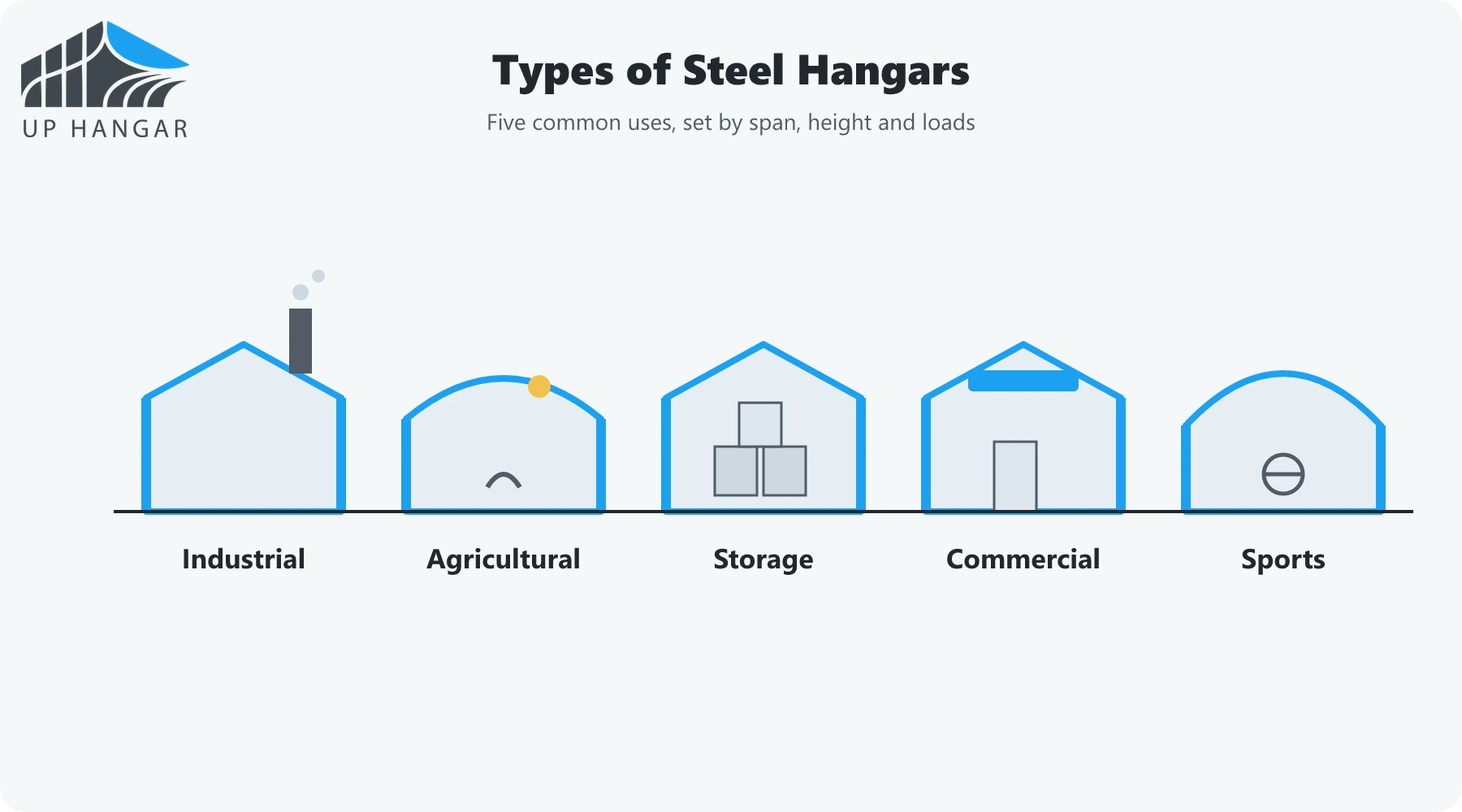
The frame types suited to warehouses range from the portal frame for spans up to forty metres to lattice solutions for wider ones, the type chosen by span, height and load. The types are detailed in the diagram below and in the parent guide.
4. Industry, the refinery and internal heat
Alongside its logistics role, Homs is a heavy industrial city with its refinery and plants. An industrial facility that generates internal heat — from machinery or thermal processes — poses the opposite challenge to the coast's: not salty humidity but accumulated heat needing ventilation and discharge studied in the design.
A high-roofed industrial hall helps discharge rising heat, and suitable ridge openings and ventilation prevent it from building up under the roof. These considerations are studied in design according to the actual industrial process, because a heat-generating plant differs in ventilation from a cool warehouse for dry goods.
Homs's hot, exposed interior summer makes insulation a practical decision in buildings that are occupied or that store sensitive goods; the annual cooling cost of an uninsulated building quickly eats what was saved on insulation. The choice of cladding and insulation follows the use and climate, not the budget alone, detailed in the complete guide to steel hangar construction.
The design conclusion for Homs: the logistics warehouse is designed around movement and capacity, the industrial facility around heat and ventilation, and both benefit from the steel frame's open space and speed of delivery. The central location remains the unifying advantage that makes Homs the first choice for national distribution.
5. Cost and time for a warehouse in Homs
Distribution warehouses in Homs usually fall in the medium-to-large category. Our actual durations include the foundations: a medium space (25–30 m span / 1,000–1,500 m²) about 45 to 50 days, and a large one (35 m+ / 2,000 m²+) about 65 days. This speed serves a logistics operation wanting to go live as quickly as possible.
Cost is measured by the tonne: the raw tonne runs roughly between 800 and 1,050 dollars, and fabricated and erected between 1,150 and 1,500 dollars, at a frame weight of 28 to 40 kilograms per square metre depending on span, height and load. A light warehouse for dry goods sits at the lighter end, and a tall or insulated one at the heavier end.
Homs's logistics advantage shows in the transport item itself: its proximity to supply axes eases the cost of hauling the structure compared with remote sites. Even so, foundations remain estimated after a soil test, not before it, so anyone who gives you a foundation cost without a test is giving you a number resting on nothing. Ask for an explicit breakdown of items in the steel hangar quotation.
Cost is paid in instalments tied to milestones: a deposit on contract, then payments on the structure's arrival, on erection and on handover. This order protects both parties and keeps fabrication flowing, and any slip in the payment schedule reflects directly on the timeline.
6. We build across Homs and the centre: the next step
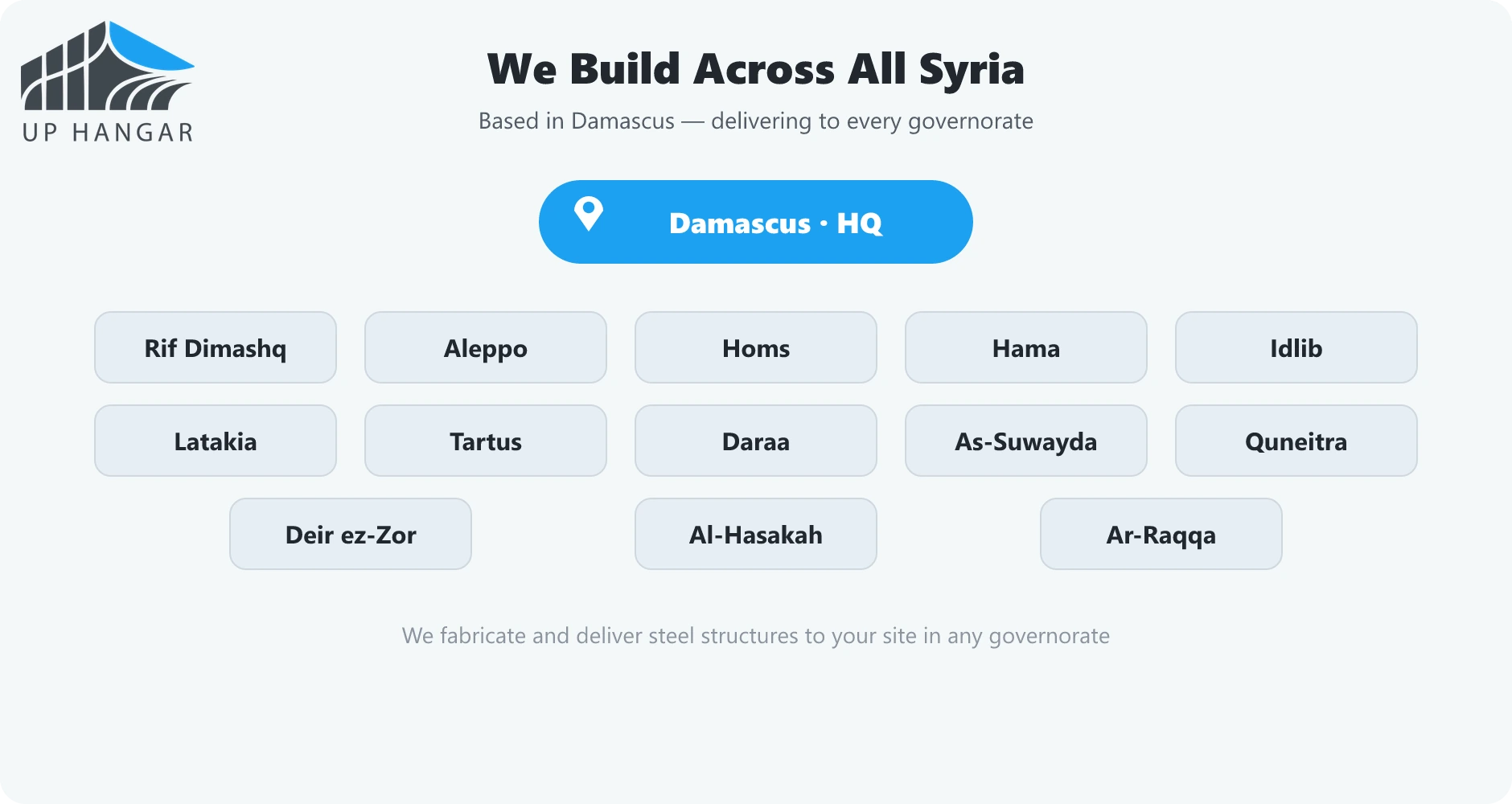
We build in Homs, Hisya and their surroundings and all governorates, with periodic maintenance after handover and a 15 to 25 year warranty. What changes in a logistics project is the span, height, movement layout and insulation by goods — not the quality of the work nor the protection specification.
Common questions:
Why is Homs a preferred location for distribution centres? Because of its central position linking all the governorates in less distance and time, so a warehouse reaches the national market with an efficiency a peripheral site cannot provide.
How does a distribution warehouse differ from a factory? A warehouse is designed around movement and capacity: an open space, storage height, and multiple doors and loading docks, and it may not need a heavy overhead crane like a factory.
When do I need insulation or refrigeration in my warehouse? When the goods are heat-sensitive. Insulation with a vapour barrier prevents condensation, and actual refrigeration for food and pharmaceuticals moves the design into cold storage.
Contact us to discuss your warehouse or distribution centre in Homs, or request a quotation with your dimensions, use and type of goods.
- Homs
- Hisya
- Distribution warehouses
- Logistics
Frequently asked questions
Why do distribution warehouses cluster in Homs?
Because of its central position linking north with south and coast with interior, so a warehouse reaches any governorate in less time and distance than a peripheral site. This location is a direct economic advantage, not a mere geographic detail.
How does a logistics warehouse design differ from a factory?
A warehouse is designed around movement and capacity: a wide open space, an eaves height for high storage, and multiple doors and loading docks for trucks and forklifts, and it may not need a heavy overhead crane like a factory.
What is the advantage of Hisya Industrial City for logistics projects?
Hisya is one of the largest industrial and logistics clusters in the centre, and its position on the Damascus–Homs axis reinforces the distribution role. Its facilities blend industry with storage, a mix suited to the steel frame for its speed of delivery.
Do I need insulation in a distribution warehouse?
It follows the type of goods. Dry, insensitive goods may suffice with simple cladding, while heat-sensitive ones need insulation with a vapour barrier to prevent condensation, and food and pharmaceuticals move the design into cold storage.
How long and how much for a warehouse hall in Homs?
A medium one (25–30 m / 1,000–1,500 m²) takes about 45–50 days and a large one (35 m+) about 65 days including foundations. Cost is by the tonne: raw 800–1,050 dollars and fabricated and erected 1,150–1,500 dollars at 28–40 kg/m².
Have a project like this?
Leave your number and a short brief, and we will come back with a preliminary study and clear quotation items within one business day.
Read next
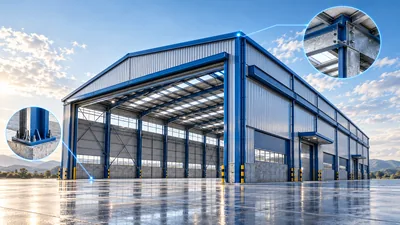 The complete guide
Steel hangar construction: the complete guide
Everything a decision-maker needs before building a steel hangar — from span and cost to protection and build time, with figures from delivered projects.
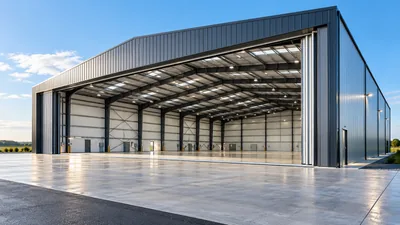 For sale
Steel hangars for sale in Syria
Buying a steel hangar is not picking a product off a shelf; it is ordering a structure engineered to your use and your site. Here is what you buy, how, and at what price.
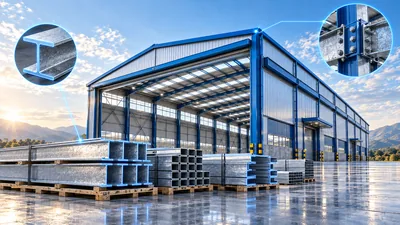 Cost and pricing
How much does a steel hangar cost?
Cost is calculated by the tonne, not the square metre alone. Here are the real price items, and where a cheap quote is a trap.