
Engineering principles are the same everywhere, but execution is local: site soil, truck and crane access, municipal requirements, wind and climate conditions, even the payment sequence. We work in Damascus, its countryside, and all governorates, and have delivered on varied sites from industrial warehouses to hangars erected on factory roofs. This article gathers what differs on the ground when you build a steel hangar in Damascus and Rif Dimashq specifically: from soil and foundations to the municipal licence, the climate, access, build time and payment staging, so a decision-maker knows what to expect before starting and is not surprised by a local item they had not planned for.
Note: The local considerations are general and vary by site; they do not replace a soil investigation, a signed structural study for the specific project, and a licence from its municipality.
1. How does soil affect foundations locally?
Soil varies from site to site within Rif Dimashq itself — between soft agricultural land in the Ghouta, rocky ground in the higher areas, and fill in some newer industrial zones — and it determines foundation size and cost before anything else.
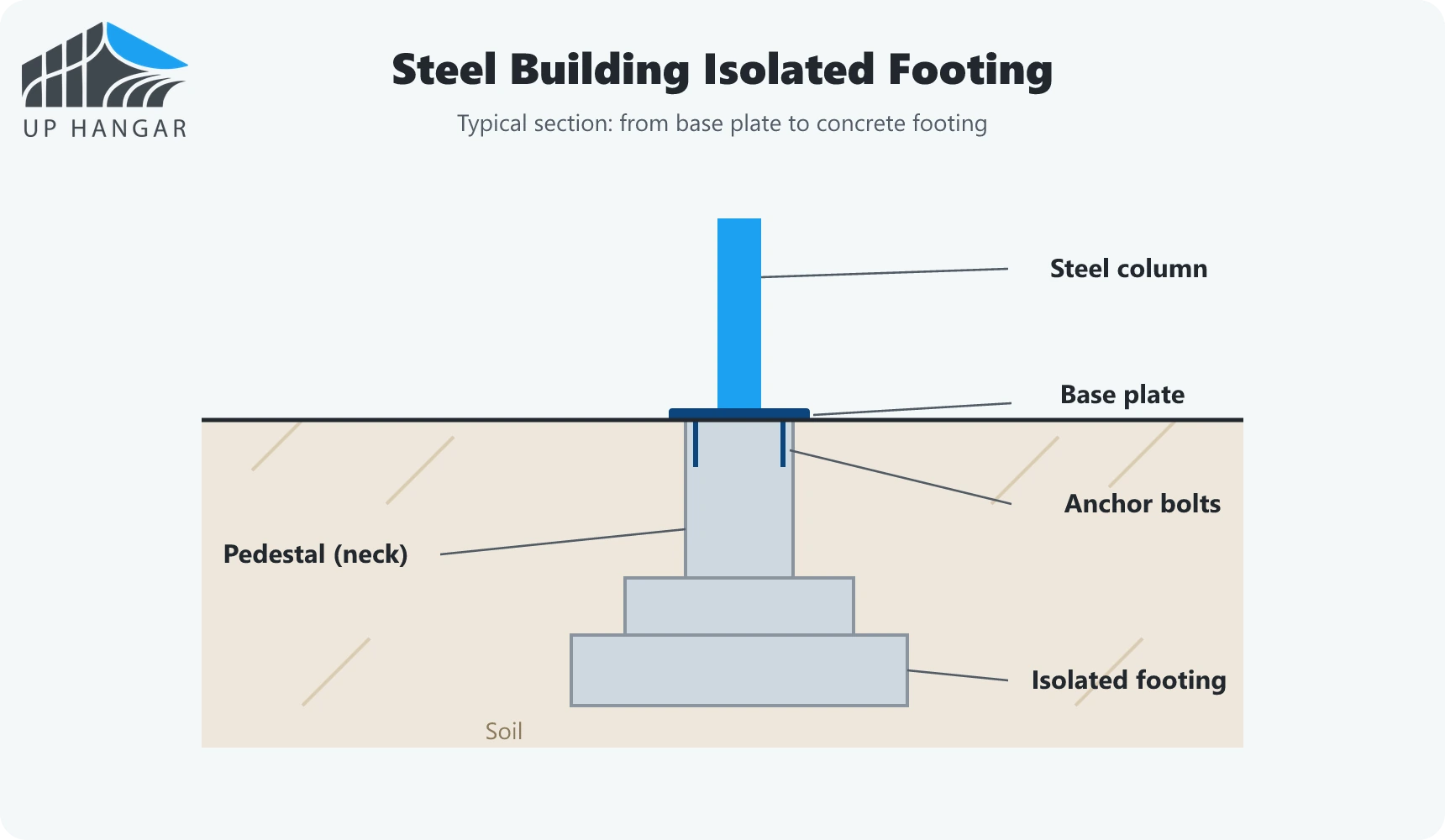
A steel frame is light, so its isolated footings are smaller than a concrete building of the same function, which is a real advantage on weak soil. But uplift tension under wind stays decisive: a light building can be lifted by wind, not only pushed, and on many sites that governs the footing design more than the downward load does.
The strict practical rule: foundation cost cannot be estimated before a soil investigation, because the soil bearing capacity sets the footing area, depth and reinforcement. Firm ground means smaller footings and lower cost; fill or soft ground means larger footings or ground treatment that can be a significant budget item. Anyone who gives you a foundation cost before a soil test is giving you a number resting on nothing. See steel building foundations explained for what actually gets calculated.
2. Why is site access a real consideration?
The structure arrives on trucks and is lifted by cranes. A site with tight manoeuvring or difficult access — common in dense industrial zones, on city edges, and on plots hemmed in by existing buildings — raises transport and lifting cost and complicates the erection sequence. It may force splitting the structure into smaller pieces, working within limited hours, or using a larger and costlier crane than the weight alone would need.
That is why we study access early, not on erection day: the width of the approach road, the ground capacity to carry the crane, the manoeuvring space around the building, and overhead obstructions such as cables. Access surprises cost more than structure surprises because they appear with the crew already on site.
From our projects: three hangars on a factory roof in Rif Dimashq — erecting over a working roof imposed real constraints on crane positions, lift order and the lift path above a live, operating facility, a clear case of the site reshaping the erection plan. In Damascus we built an industrial warehouse at a 37 m span.
3. What does the municipal licence require?
In practice a municipal licence is required, usually obtained by the client, and its duration follows the municipality and area with no fixed figure. The procedures and documents differ between one municipality and another within Rif Dimashq itself, so what is accepted in one area may need extra paperwork in another.
The golden rule: start the licence process early and in parallel with design, not after it. Waiting on paperwork once design and fabrication are ready is delay for nothing, and can idle a crew ready to work. Because fabrication runs in parallel in the shop, both tracks can advance together if the licence is begun early.
What we provide is the structural calculation, fabrication, erection and the necessary technical drawings; the municipal paperwork usually stays the client responsibility, and we support it with the documents and drawings the municipality asks for. Practical detail in building permits for steel hangars in Syria, and the full picture in the complete guide to steel hangar construction.
4. How do wind and climate enter the design?
Design wind speed varies by location and enters the calculation directly, and a light steel building is more sensitive to uplift than a heavy concrete one. That is why load values are fixed in the contract, not in conversation — they govern the structure weight and its cost: raising the design wind value raises the weight, and lowering it below reality saves tonnes today and buys a risk in the first storm.
Climate is a second, no less important factor. The hot Damascus summer makes insulation an operating decision rather than a luxury in buildings that are occupied or that store heat-sensitive goods; the annual cooling cost of an uninsulated building quickly eats what was saved on insulation. And some higher parts of Rif Dimashq can carry snow that enters the roof load and must not be neglected.
The insulation thickness (5, 6, 8 and 10 cm) and cladding type (sheet, sandwich panel or skorit) follow this use and climate, not the budget alone. See cladding and insulation: preventing condensation and leaks and how is the cost of a steel hangar calculated?.
5. How long does construction take locally?
Our actual durations, including foundations and not the structure alone: small (15–20 m span / ~500 m²) about 30 days, medium (25–30 m / 1,000–1,500 m²) 45–50 days, and large (35 m+ / 2,000 m²+) about 65 days. The secret is the parallel between shop fabrication and site foundation pouring, so when the steel arrives the work is assembly, not fabrication.

Locally, three things cause most delays, and all are in the client hands, not the contractor: weather in the rainy months, late payments that halt fabrication while funding is awaited, and a site not handed over cleared of occupation or rubble.
What you do to speed your project: hand over a ready, cleared site, keep to the payment schedule precisely, approve shop drawings quickly as soon as they arrive, and fix your requirements early so they do not change after fabrication starts. Detail in how to build a steel hangar: step by step and site erection: the right sequence.
6. How do cost and payments differ by location?
The steel price itself does not change from one governorate to another, but the total cost does, for local reasons: the soil that governs the foundations, the access that governs transport and lifting cost, and the distance over which the structure is hauled from the shop to the site. Two sites identical in area and specification can differ in final cost because of these local items alone.
That is why we set out the scope explicitly: what is in (structure, cladding, protection) and what follows the site (foundations after a soil test, transport, lifting). An honest quotation states these items rather than staying silent so they return as a surprise. The full price breakdown is in how much does a steel hangar cost? and steel structure cost per ton.
7. Where we build: a guide to governorates and industrial cities
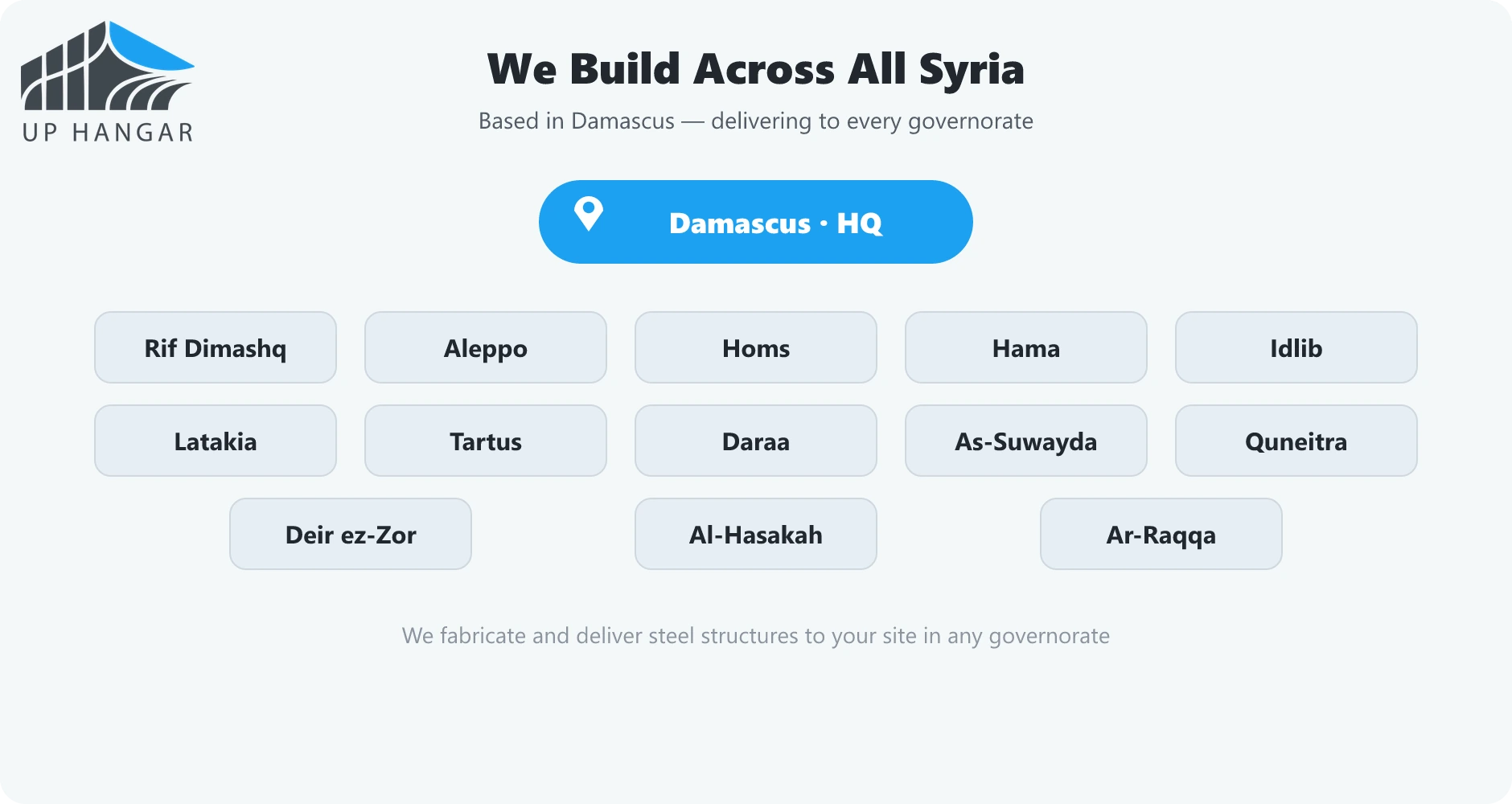
We build across all governorates, and each area has its local considerations — climate, soil and dominant use. We have written a dedicated guide for each, explaining what differs on the ground:
The coast: Lattakia and Tartus (corrosion and marine humidity). Centre and north: Rif Dimashq, Aleppo, Homs, Hama and Idlib. South and highlands: Daraa, Sweida and Quneitra. East and the Jazira: Deir ez-Zor, Raqqa and Hasakah.
Industrial cities: Adra, Sheikh Najjar, Hisya and the Deir ez-Zor industrial city.
If you are on the buying side directly, the guide to steel hangars for sale in Syria explains what you buy, how and at what price.
8. We work across all governorates, and the next step
We build in Damascus, its countryside and the other governorates, with periodic maintenance after handover and a 15 to 25 year warranty. What changes between one governorate and another is the soil, access, licence and wind — not the quality of the work nor the protection specification.
Common questions:
Do you need a soil investigation for every site? Yes, because the soil governs the foundations, and their cost cannot be honestly estimated without it.
Who obtains the licence? Usually the client, and we supply the technical documents and drawings the municipality requires.
Does cost differ by location? Yes, because of soil, access and transport — not because of the steel price itself.
Do you build outside Damascus and its countryside? Yes, across all governorates, at the same specification and warranty.
Contact us to discuss your site in Damascus or its countryside, or request a quotation with your dimensions and use, and see our delivered projects.
- Syria
- Damascus
- Soil
- Municipal licence
Frequently asked questions
Do you build hangars in all governorates?
Yes, we build in Damascus, its countryside and all governorates, with periodic maintenance after handover and a 15 to 25 year warranty. What changes between governorates is soil, access and the licence, not the quality of the work.
How does soil affect the site foundations?
Soil determines footing size, and its cost cannot be estimated before testing. Firm ground means smaller footings, and fill or soft ground means larger footings or treatment. Footings are isolated under each column.
Why is site access an important consideration?
The structure arrives on trucks and is lifted by cranes, so a site with tight manoeuvring or difficult access raises transport and lifting cost and complicates erection. Access is studied early, not on erection day.
Who obtains the licence in Damascus and its countryside?
Usually the client, and we supply the technical drawings and specifications the municipality requires. The duration follows the municipality and area, so start early in parallel with design.
Does cost differ between governorates?
The steel price does not change, but the total cost does, through the soil that governs foundations and the access that governs transport and lifting, not through the metal price itself.
Have a project like this?
Leave your number and a short brief, and we will come back with a preliminary study and clear quotation items within one business day.
Read next
 The complete guide
Steel hangar construction: the complete guide
Everything a decision-maker needs before building a steel hangar — from span and cost to protection and build time, with figures from delivered projects.
 For sale
Steel hangars for sale in Syria
Buying a steel hangar is not picking a product off a shelf; it is ordering a structure engineered to your use and your site. Here is what you buy, how, and at what price.
 Cost and pricing
How much does a steel hangar cost?
Cost is calculated by the tonne, not the square metre alone. Here are the real price items, and where a cheap quote is a trap.